The business case is a deck someone emailed at kickoff. Status is in PowerPoint. Risks are in Confluence. Decisions are buried in meeting minutes across a dozen folders. Budget is in a spreadsheet that disagrees with the ERP. Every reporting cycle, someone reassembles the picture by hand — and it's stale before it reaches the room.
Then the committee asks the follow-up. “What did we decide about that change in Q2? What has it cost us? Which work packages are exposed?” And nobody in the room can answer without going away to dig — which is where the meeting stops being useful.
Tollgate sits above the ERP, the finance system and Jira, drawing the governance-relevant slice of each into one place that stays current. What follows is the journey it puts that picture through.
Every investment Tollgate governs moves through the same arc your steering committee already runs on instinct.
The sponsor's question: Is this worth funding?
Write the thesis, build the financial case, put it through the gate. No money moves until someone's name is on the decision.
The sponsor's question: Is it still worth it?
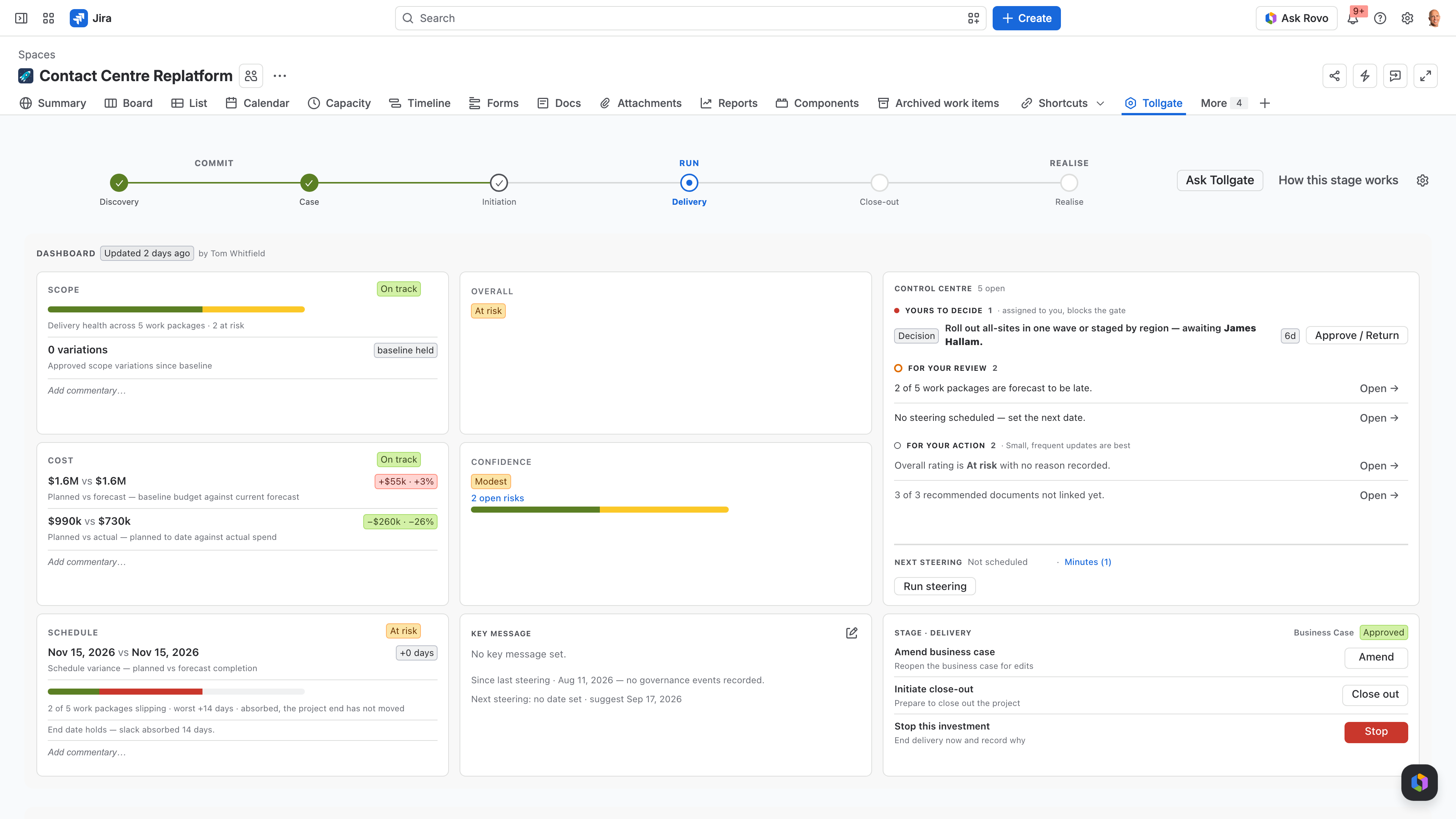
Scope, risks, decisions and changes stay live. Cost, schedule, scope and risk status derive themselves from the registers — no colour you can wish green.
The sponsor's question: What did we actually get?
Close it out, then judge whether the benefits landed. Tollgate holds the verdict — expected next to realised — and refuses to fake a number.
Commit starts with the investment thesis — one clear sentence each for the business problem, the outcome, and the return you're funding this for. Plain language a sponsor can read aloud. Then the financial case computes the numbers that make it a case: NPV, IRR and payback, held as the targets you're committing against.
From there it goes through the gate. The sponsor approves, returns it with structured notes, or archives it with dignity as an option considered and shelved — all first-class paths, none of them a failure state. Only the named decision authority can approve, and never their own case. That separation is what makes the approval mean something later.
One sponsor, accountable for the call, by name.
Whether people will actually take up the change is the one point of genuine required completeness, because it's the best predictor of whether the investment lands.
NPV, IRR and payback as what “worth it” was defined as — the yardstick Realise measures against.
Once an investment is chartered, the work of governing it is keeping four things honest: work packages (business-level slices of scope, budget and dates, one level above the ticket), risks (a register that sorts itself by impact and likelihood), decisions (append-only corporate memory, no quiet edits), and changes (scope, timeline and budget requests, approved by the same separation-of-duties gate as everything else).
Here's the part that changes the conversation. Cost, schedule, scope and risk each get a status card, derived deterministically from the registers underneath — nobody sets the colour by hand. If cost is amber, it's because the numbers made it amber. The sponsor gets a status straight from the data, immune to being massaged before the meeting. The one card you set by hand is Overall — and when your Overall disagrees with a derived card, that gap is the most useful prompt on the page: “Overall's green but schedule's red — talk me through that.”
Alongside the RAG, you record confidence on two axes — will it deliver the outcome, and will people adopt it. RAG says where things stand now; confidence says where you think they're heading. Declaring it is itself a governance act: you, on the record, calling it.

Scope, budget and schedule at a level the sponsor thinks in.
Downside, opportunity and materialised, ranked automatically. Always called risks, no euphemisms.
Append-only. What was approved, by whom, and when.
Scope, timeline and budget requests, gated the same way.
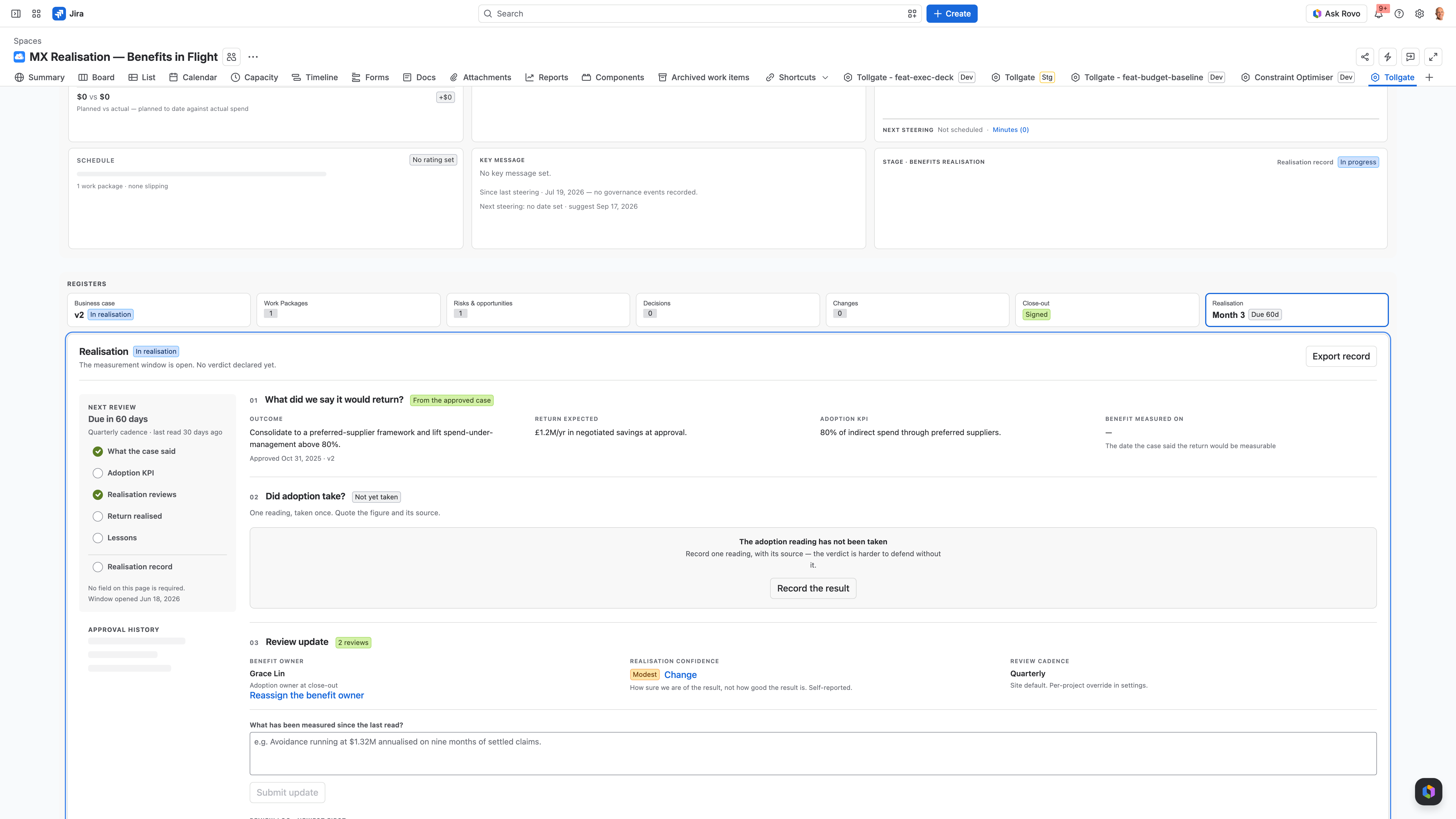
When the work is done, the investment is closed out: the as-built outcome, residual risks dispositioned, lessons captured, handover to business-as-usual acknowledged. Then, on a review cadence, comes the verdict — did the benefits land?
Plenty of tools will hand you an ROI figure here. Counterfactuals are invisible, attribution windows are long, and a confident-looking number computed from contested inputs is worse than no number. So Tollgate holds the artefact that actually survives scrutiny: the return you expected, sitting next to the return you got, in the sponsor's own words. The declaration is the governance act. The pair is the verdict.
That honesty is the point. A governance tool that fakes the hardest judgement in the process forfeits trust on all the easier ones.

You put Investment Health on the projector and run the meeting from data that's already current.
This is the one Tollgate is built for. You walk into the steering committee, put Investment Health on the projector, and run the whole meeting from live data. The thesis reminder is your opening. The RAG cards are the status. The decisions-needed block is your agenda.
When someone asks a follow-up, you don't leave the room. You're one click from any register — risks, changes, the decision log — and for the broader question you use Ask Tollgate, which answers from current data, in plain language, while the room waits. The follow-up gets answered on the spot.
Presentation-grade is the default state. The typography, density and contrast are built to hold up projected to a room of executives. You maintain the picture through the week; the picture is what you present.

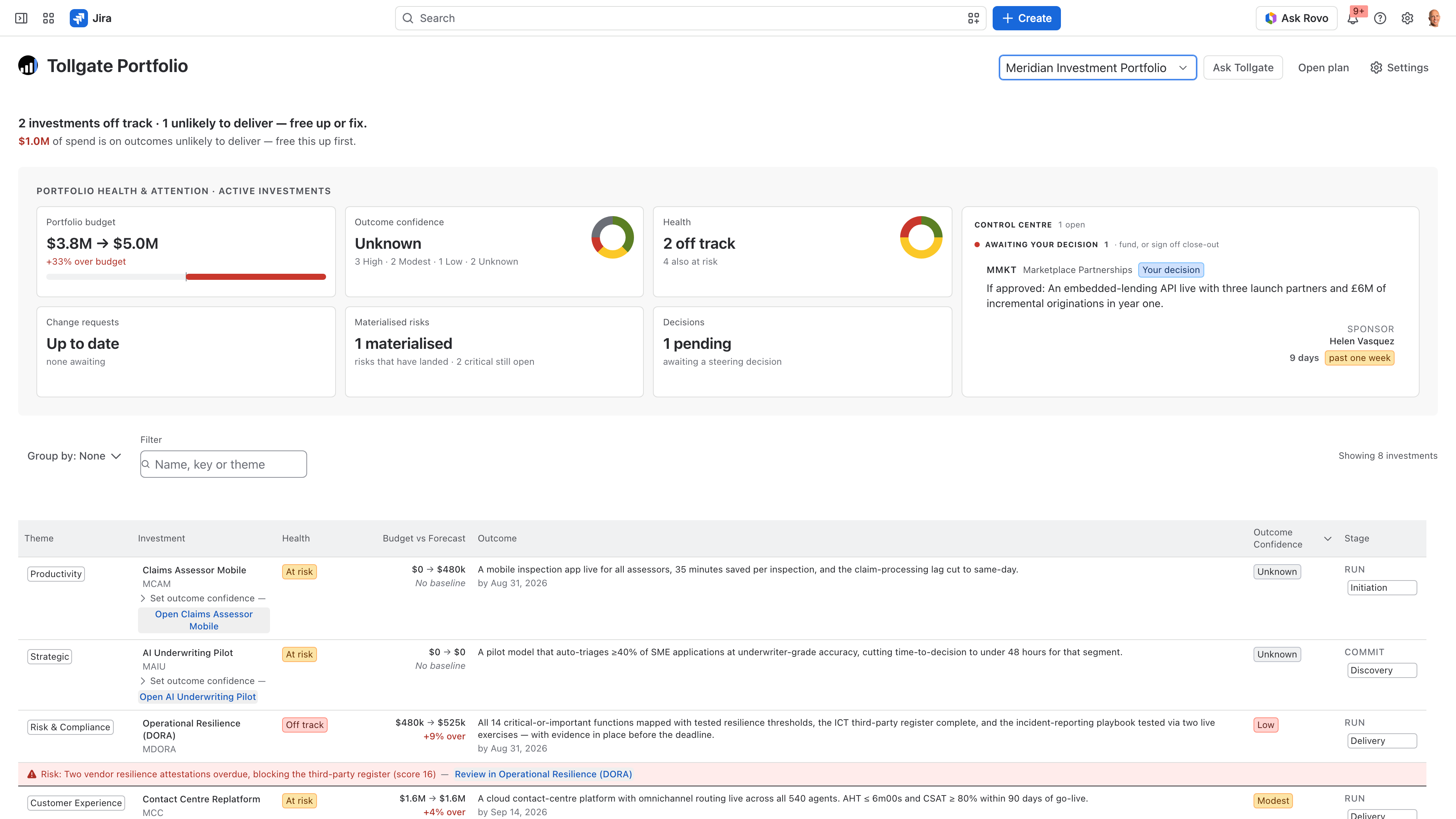
If you're answerable for a whole portfolio, the Portfolio page does one level up what Investment Health does for one investment. Theme swimlanes, RAG distribution, investments overdue for an update, total portfolio spend — and one click down into any single investment when the room wants the detail. Same live surface, same present-from-it-directly move, no separate roll-up deck to keep in sync.

Tollgate runs natively on Atlassian Forge — a tab on each Jira project and a portfolio page under Apps. Your data stays inside your Jira instance, under the same security and residency boundary as the work itself. Ask Tollgate is built on Atlassian Rovo — available on Jira Premium and Enterprise — so the AI stays on-platform too. Nothing is copied to an external system. Governance visibility is gated by a group you manage, so the surface stays above the line — invisible to the delivery teams below it.
Sprints, velocity and burndowns stay in Jira, where they belong.
It captures the governance view of the money. The capital lifecycle stays in your ERP.
The methodology is the product. Fewer knobs, on purpose.
The dashboard is the deck. There's nothing to export and re-flow.

Thirty minutes on a call is faster than another cycle of reassembling the deck by hand. We'll walk an investment from thesis to gate to verdict on the live surface — then you decide if it fits.
There's no pressure on the call. If Tollgate isn't the right fit for how you govern, we'll say so.