Three people, three problems, one surface

Governance touches everyone above the line. Each of them needs something different from it.

PMO / PM

You're the human glue holding five systems together every reporting cycle.

See the PMO view
Sponsor / executive

You have to defend the investment, in the room, with an answer ready now.

See the sponsor view
Delivery lead

You'll approve the install — as long as it doesn't touch your Jira setup.

See the delivery view
For the PMO and portfolio lead

Stop being the integration layer

Replace the spreadsheet registers and the reassembled deck with one workflow that holds itself together.

Every reporting cycle is a reassembly job. Risks in Confluence, decisions in meeting minutes, the business case nobody's reopened since kickoff, the status in last month's PowerPoint. None of it talks to each other, so you become the thing that makes it talk. The picture is stale before you've finished building it.

Tollgate holds the governance-relevant slice of all of it in one place, inside Jira, next to the work. Risks, decisions and changes live as structured registers, with fields, owners and status. Approvals have separation of duties built in — the person who raises a change can't be the person who signs it off. The decision log is append-only, so the record of what you approved survives the next reorganisation. You maintain it through the week; the dashboard is already current when the meeting starts.
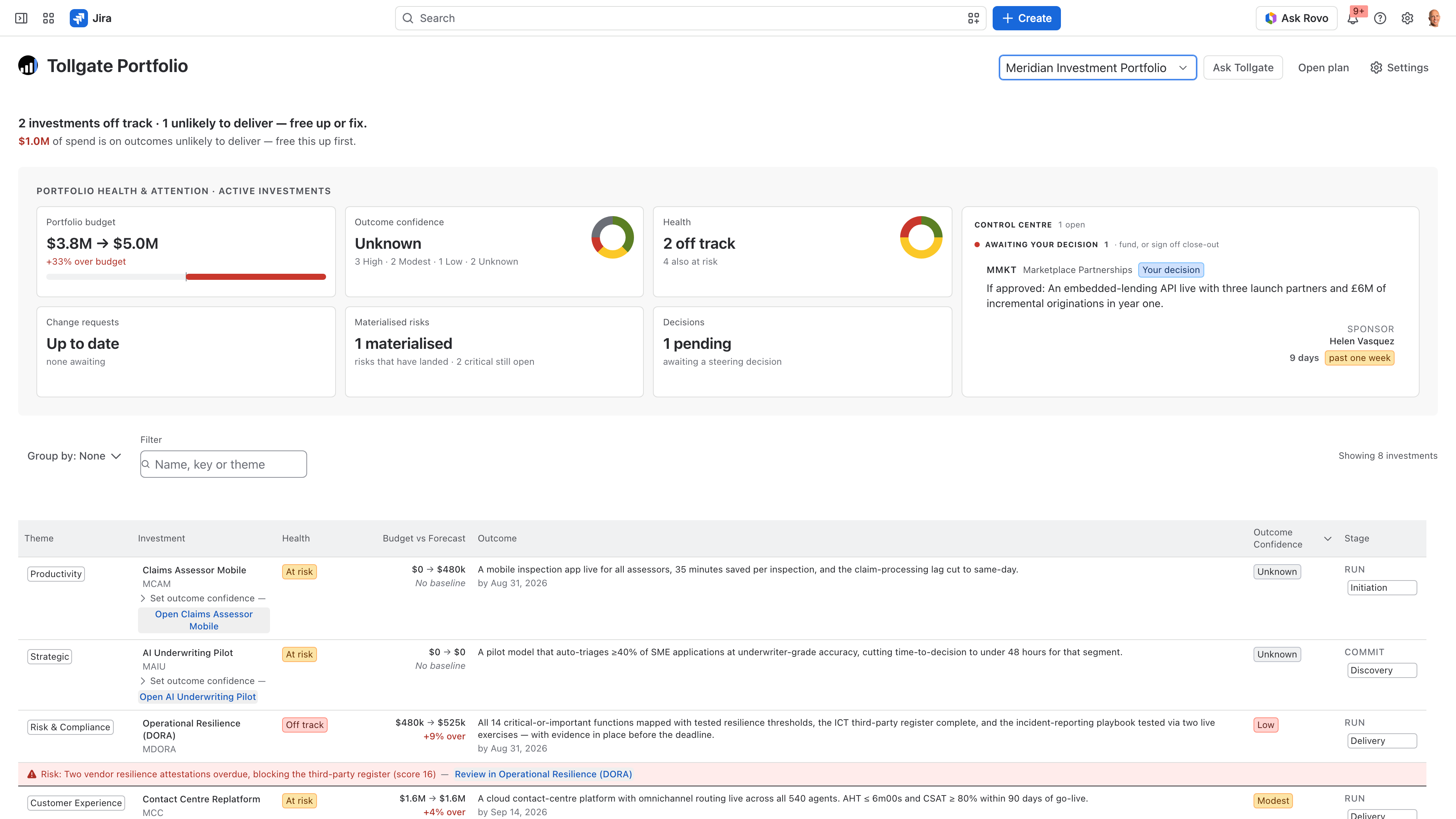
Tollgate Portfolio Health page: every programme's registers and status in one live view inside Jira

Before Tollgate

— Registers scattered across Confluence, SharePoint and email

— A deck rebuilt from scratch every reporting cycle

— A different version of the same risk or decision in every file

— You are the audit trail

With Tollgate

— One register per record type, inside Jira

— The dashboard is the deck: nothing to rebuild

— Append-only decision log, versioned business case

— The audit trail keeps itself
For the delivery lead and Jira admin

Governance that leaves your Jira exactly as it is

No new issue types, no schema changes, no double-keying — the governance layer sits above the line and stays there.

You've seen PPM tools that want to restructure your project to work. New parent levels, custom issue types, workflows your team has to learn and route around. The answer is usually no, and reasonably so.

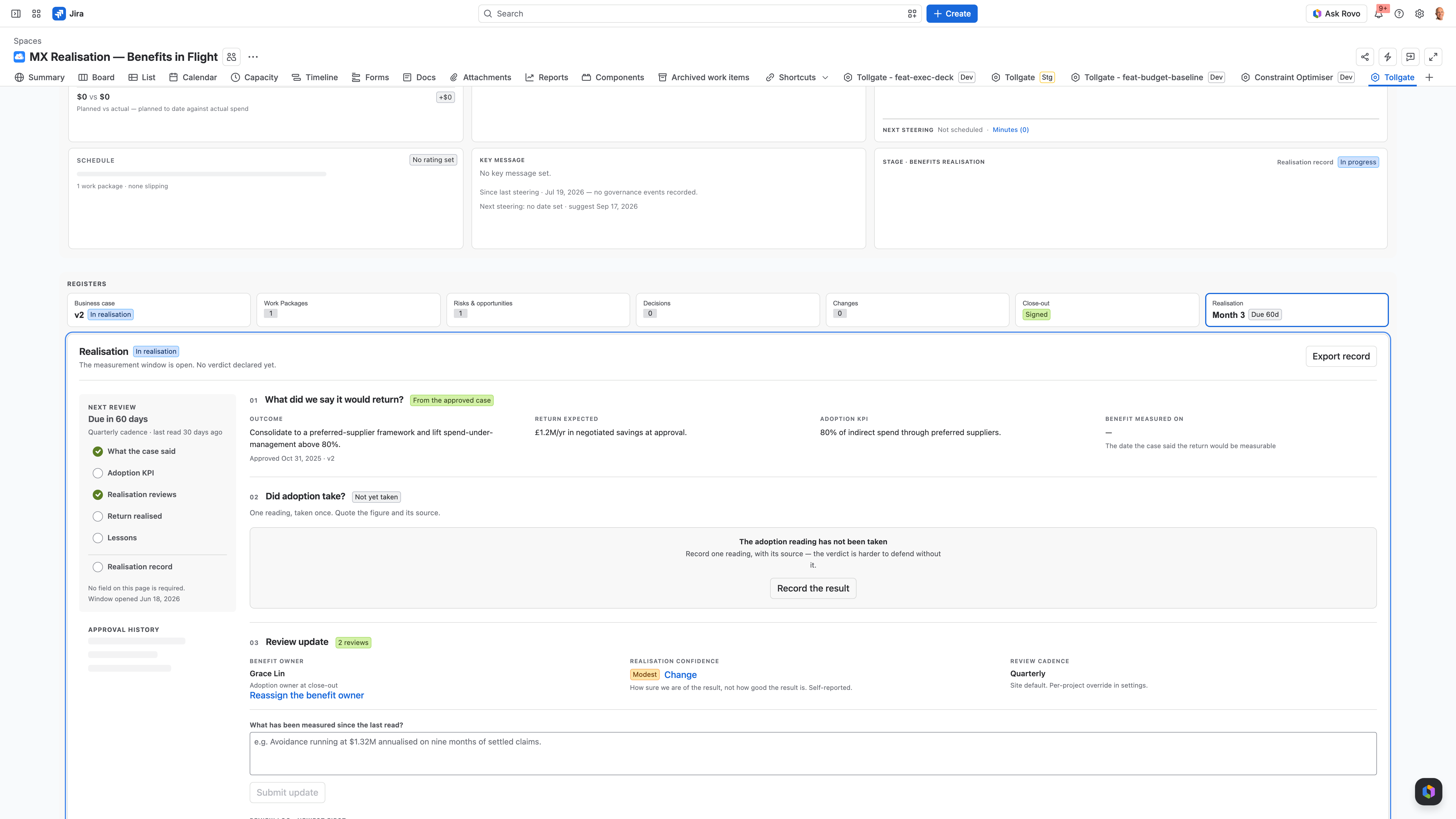
Tollgate is Forge-native and app-native. Work packages live in Tollgate as their own governance-native record — they link to your epics by key, so the sponsor's view never collapses into a wall of tickets and your delivery data is never re-entered by hand. Delivery keeps churning underneath: stories split, sprints slip, epics move. None of it rewrites what the steering committee approved. Governance is gated to a group you manage, so it's invisible to the delivery team. You approve the install once, and it changes nothing about how your team already works.

Tollgate Realisation view: the governance layer sitting above delivery without touching Jira configuration
Sector scenario

When the audit trail is the deliverable

For regulated and government-adjacent programmes, where every decision has to survive scrutiny long after it's made.

In a regulated programme, an auditor wants a paper trail: what was approved, by whom, on what date, against which business case, and what it cost. Tollgate keeps that record as a matter of course, built up gate by gate as the programme runs.

A record that holds up

The decision log is append-only. Every entry stays on the record, permanently. The business case is versioned, so you can show what the investment was justified on at each gate.

Separation of duties, enforced

The person who raises a change or a decision can't be the one who approves it. The control sits in the workflow itself, enforced automatically.

Framed to your assurance model

Framework framing presets let you sit the governance record inside the assurance language your programme is held to — Australian and UK public-sector investment frameworks among them.

Sector scenario

Serious governance without the enterprise tax

For mid-market technology teams running multi-million-dollar programmes on Jira, who need investment governance — not a six-figure PPM suite.

Between the spreadsheet and the enterprise PPM platform there's a gap, and that's where most mid-market programmes actually live. The spreadsheet doesn't survive a steering committee. The enterprise suite costs more than the governance is worth and takes a quarter to stand up. Tollgate sits in the tool your team already pays for, and gives a sponsor a serious surface for the money conversation without any of that weight.

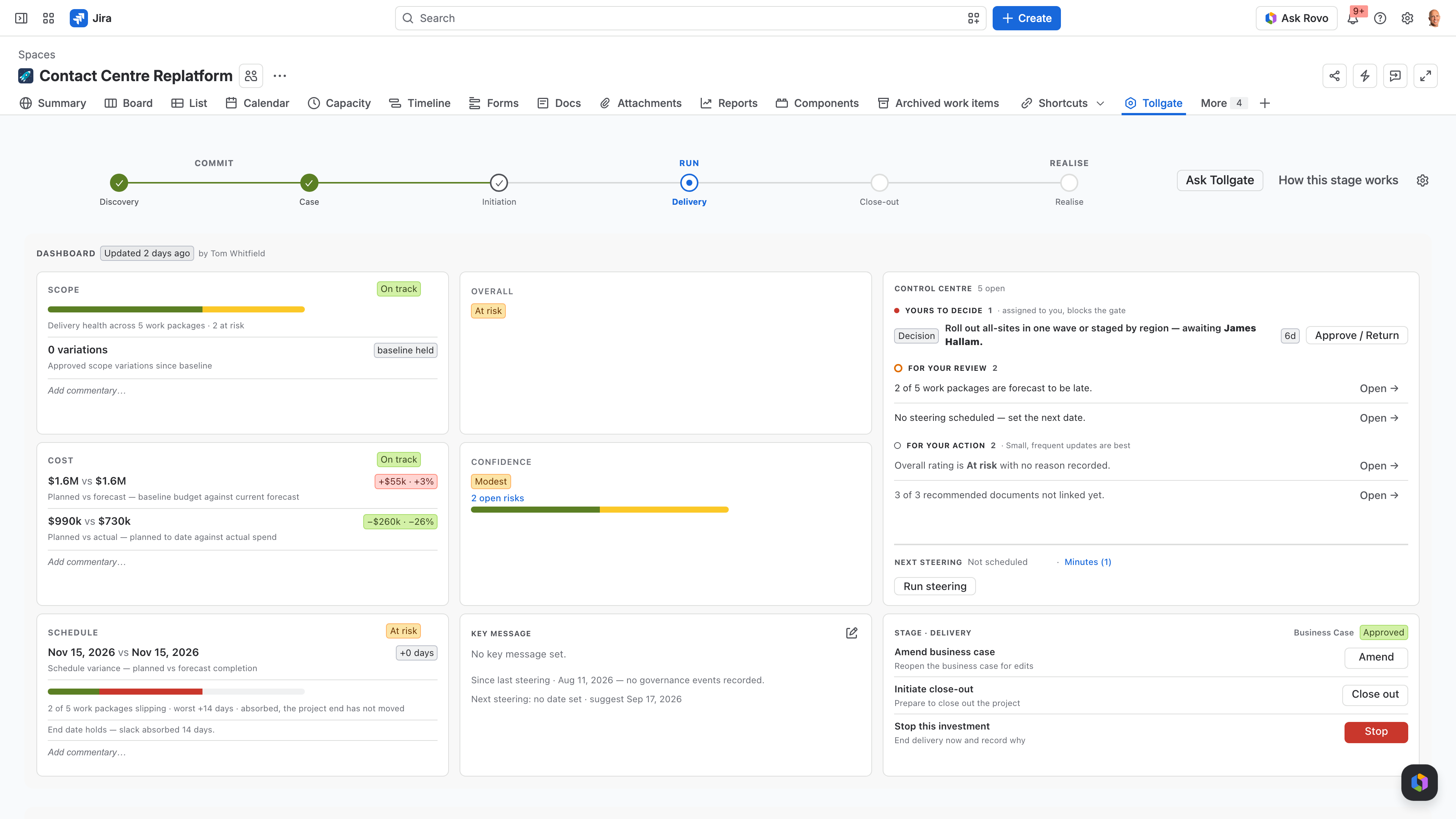
It follows the arc of the investment: Commit, Run, Realise. You set the thesis and the business case, run the programme through gate approvals with the registers keeping the record, and close the loop with a realisation verdict — the return you expected, set next to the return you got. A judgement, on the record, defensible.

Commit

Thesis, business case, gate approval

Run

Work packages, risks, decisions, changes

Realise

Return expected, next to return realised

See it on your own programme

Bring a real investment to the call. We'll show you where it would live in Tollgate, and what your next steering committee looks like without the deck.