Tollgate is the investment governance layer for Jira — the current, defensible case file a sponsor brings to a steering committee, kept in the tool where the work already lives. It exists because we spent twenty years assembling that case file by hand, and got tired of it.
Tollgate is built by Softwired — an Australian digital transformation, delivery and change consultancy.
We are practitioners who have sat on the accountable side of the table — running and governing multi-million programmes across mining, financial services, education and health, the kind of high-stakes work where a governance failure reaches the boardroom.
Senior people, embedded with the team, every time. Tollgate is the tool we kept wishing existed on those engagements, so we built it.
Tollgate is the work of James Hallam, Softwired's founder and principal consultant, and the practitioners around him.
In the field, on real programmes
Mining, financial services, education, health
Brisbane, working with teams worldwide
Tollgate is the software form of a method we refined in the field — the Softwired ATL Method (SAM): governance above the line (ATL).
The method is a small set of principles we found held true on every serious programme, whether it was a core-banking replacement or a mine-site systems rollout. Few principles, held deeply. The life of an investment runs in three acts, and each is a sponsor asking a sharper version of the same question.
Is this worth funding? A hypothesis, pressure-tested and written down, with every alternative explored kept on the record.
Is it still worth it? The case file stays current through the week, so the sponsor gets a straight answer while the question's still live.
What did we actually get? The verdict, in the words of the person who signed the cheque — and the failures preserved as carefully as the wins.
The methodology is the product, and the constraint is the feature. Tollgate says no to ticket-level rollups, capacity planning, sprint metrics and slide exports — because each of them drags the tool below the line, back into delivery detail, where it stops being the sponsor's view of the money. Fewer things, done properly, in the sponsor's own vocabulary.
It scaffolds good governance and leaves the calls to the accountable human. Human judgement, scaffolded — Tollgate makes the right things easy and the important things hard to lose, but it does not make the decision for you, and it does not pretend to. That has always been the job of a person with skin in the game.
If you want a tool that configures endlessly and reports on everything, this isn't it. If you want the one question your steering committee keeps asking answered properly, it is.
Tollgate is opinionated and stays that way. When we learn something in the field worth encoding, it earns its place on the governance surface — as new depth where it belongs, never configurability for its own sake. What it does, it does properly; what it refuses, it refuses on purpose. The product grows the way the practice does: opinionated about what matters, quiet about almost everything else.
Tollgate is a Forge app. It runs entirely on Atlassian infrastructure.
Your case file lives inside your own Jira, behind the same security and data-residency boundary as the work it governs. Everything stays inside that boundary. The assistant that answers questions in the room runs on Atlassian infrastructure, on your data, in your own tenancy — there is no external AI to brief on your programme.
For a regulated buyer, that's the line between a tool you can adopt and one legal sends straight back.
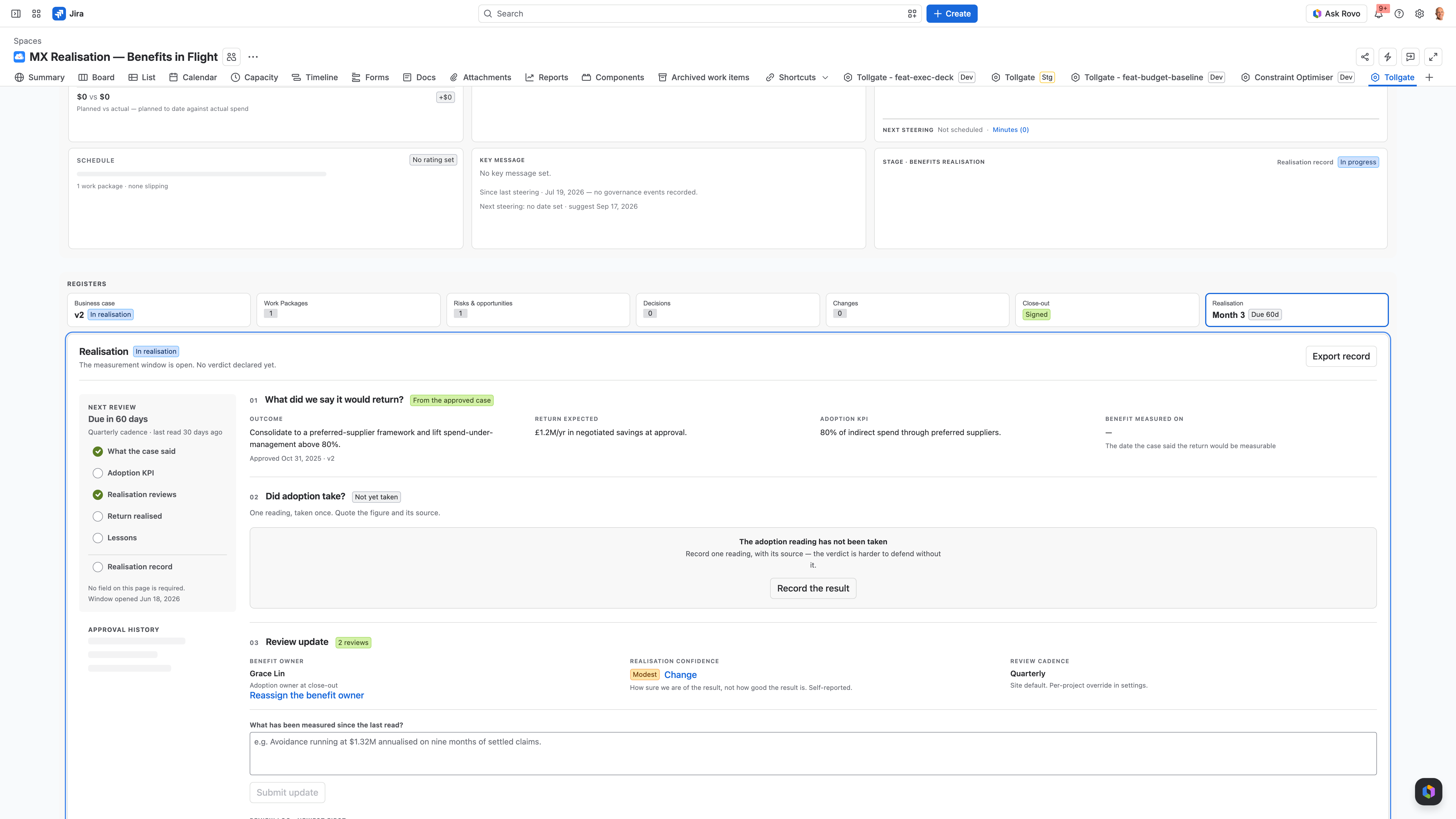
The fastest way to judge whether the method holds is to watch it run a steering committee — on your own Jira, not a canned demo.
Thirty minutes, no obligation. Bring the programme that's hardest to report on.